I had got a relatively small but cumbersome C# code to maintain and extend. Well, I was first charged with the enthusiasm of working in C#, but being a pampered VB (.NET) developer, I decided to convert (manually) the whole code to VB.NET. There were two reasons that made me decide this:
1. I could learn the whole code and what the code intended to do.
2. I was leery on making C# code changes to a working piece of software! Yes, I was too leery!
After 2 days of juggling, I got everything to VB.NET! Wow!
But when I started testing, one part of the code started breaking! :-) This was not expected (It's never expected to fail, right? :-)). I had converted a for loop in the C# code to a for loop in VB.NET.
In the C# code, an arraylist was the one which was getting "looped" and when a condition matched, on object gets removed from the arraylist. The world seemed perfect.
But, to my luck, the VB.NET code did not behave as expected.
Later, I learned that the VB.NET equivalent of the FOR loop in C# is the WHILE loop.
Good learning of the month!
Saturday, July 22, 2006


Sunday, July 16, 2006
Unrecoverable, indeed!
I have been working in VS.NET 2003 since its inception. I have deployed both ASP.NET as well as Windows Forms apps to various servers innumerable times.Today I encountered a problem, which was indeed a dead end for me. When I was trying to build a Web Deployment Setup project, VS.NET threw me a Unrecoverable Build Error. Wow!
When I googled, I found many facing this issue. All of them pointed me to the Microsoft's support site article :http://support.microsoft.com/kb/329214/EN-US/
All I needed to do was to register the Mergemod.dll.
When I googled, I found many facing this issue. All of them pointed me to the Microsoft's support site article :http://support.microsoft.com/kb/329214/EN-US/
All I needed to do was to register the Mergemod.dll.
Wednesday, April 26, 2006
On Vacation
I am going on a vacation to India for one month. I hail from the capital city of Kerala state, Trivandrum. I am planning to meet the T-MUG team in Trivanrum. T-MUG is a Microsoft User's Group in Trivandrum, a group of .NET enthusiasts. I look forward for the fun and excitement.
If you happen to be in Trivandrum, please drop me a line at rajeevg.nair[at]gmail.com and we can meet.
If you happen to be in Trivandrum, please drop me a line at rajeevg.nair[at]gmail.com and we can meet.
Tuesday, April 25, 2006
Technology and People
When does technology become a success?
When does the IF-ELSE-ENDIF statements that we key in every minute make a difference?
When?
When the technology we build make a difference in people's lives. There is a very good story on Channel9 of how two developers made a difference....Read on.
When does the IF-ELSE-ENDIF statements that we key in every minute make a difference?
When?
When the technology we build make a difference in people's lives. There is a very good story on Channel9 of how two developers made a difference....Read on.
Friday, April 21, 2006
VS 2005 Express Versions Free from NOW!
Yes, you heard right!
Visual Studio 2005 Express versions are now FREE! Believe it!
Effective April 19, Microsoft has announced that the express versions (Visual Basic 2005 Express, Visual Web Developer 2005 Express etc. etc...) are going to be FREE FOR EVER!!!
Read the entry on the ASP.NET Guru Scott Guthrie's blog:
http://weblogs.asp.net/scottgu/archive/2006/04/20/443461.aspx
Have Fun!
Wednesday, March 22, 2006
A Great Evening with Themes
It was a great evening yesterday as everyone loved it, it seems... :-)
This was my third speaking event for our user group.
My last talk was about Delegates and I know most of them did not get anything from what I talked. And I was really disappointed. May be the examples I gave was not enough or it did not make the point that I wanted to convey.
But this time, it was different. Although I stumbled for few minutes, I made that up after some time, thanks to the audience.
Wednesday, March 08, 2006
Themes and Skins - Part 2
This is a follow up on my previous post on the similarity between Skins/Themes in ASP.NET 2.0 and Styles/CSS in pre-.NET era.
A CSS file looks typically like this:
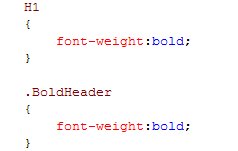
The first notation (H1) is called a Default Style. This is because all the elements with in <h1> tag would be rendered as BOLD.
The second notation (.BoldHeader) is called a Named Style. "Named", as the set of styles have a name. The phrase (word, actually) after the "." is the name given to the style. And any controls (oops! elements, I mean :-)) referring to this name would be rendered as BOLD.
I would not go in-depth, explaining the how-to about implementing themes and skins using CSS, as there are a plethora of articles in the internet.
There is a very interesting article, by Claus Augusti, about implementing Themes using CSS and Javascript. Read on!
Now, lets dive into ASP.NET 2.0. What's different in here? Here we have a .skin file (a file with .skin extension (duh!)), which defines the appearances of the controls that are used in a web page. A .skin file would "look" like an ASPX page. Like this, I mean:
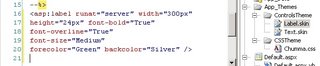
-Label.skin file-
As you see, there is no ID property in the label control. Yes, that is the only difference!
NOTE: There is no intellisense support for .skin files. So, if you need to get it done fast, you need to type it in on an ASPX page and then copy/paste into the .skin file.
Then, when you create an ASPX page, mention this theme (ControlsTheme, as you see in the above snapshot).

-An ASPX page-
So, all the labels in the page would appear as specified in the Label.skin file.
You got the gist, right?
As I posted earlier, I am speaking about the Themes and Skins in ASP.NET 2.0 in our local .NET User Group (Central Penn .NET User Group) meeting on March 21.
A CSS file looks typically like this:
The first notation (H1) is called a Default Style. This is because all the elements with in <h1> tag would be rendered as BOLD.
The second notation (.BoldHeader) is called a Named Style. "Named", as the set of styles have a name. The phrase (word, actually) after the "." is the name given to the style. And any controls (oops! elements, I mean :-)) referring to this name would be rendered as BOLD.
I would not go in-depth, explaining the how-to about implementing themes and skins using CSS, as there are a plethora of articles in the internet.
There is a very interesting article, by Claus Augusti, about implementing Themes using CSS and Javascript. Read on!
Now, lets dive into ASP.NET 2.0. What's different in here? Here we have a .skin file (a file with .skin extension (duh!)), which defines the appearances of the controls that are used in a web page. A .skin file would "look" like an ASPX page. Like this, I mean:

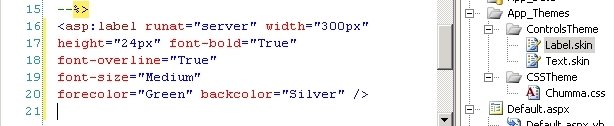
-Label.skin file-
As you see, there is no ID property in the label control. Yes, that is the only difference!
NOTE: There is no intellisense support for .skin files. So, if you need to get it done fast, you need to type it in on an ASPX page and then copy/paste into the .skin file.
Then, when you create an ASPX page, mention this theme (ControlsTheme, as you see in the above snapshot).

-An ASPX page-
So, all the labels in the page would appear as specified in the Label.skin file.
You got the gist, right?
As I posted earlier, I am speaking about the Themes and Skins in ASP.NET 2.0 in our local .NET User Group (Central Penn .NET User Group) meeting on March 21.
Subscribe to:
Posts (Atom)
-
Disclaimer: This post has nothing to do with washing or repairing cars. Well, I have been pondering over Managers and Management for lo...
-
 Yesterday I had this popup on my new Nokia Lumia 800 for a phone update. I connected it my laptop and up came the Zune. I went through the ...
-
Our application started having integration issues early March this year. Did I say that was intermittent? To add to our confusion, we coul...